
A Practical Guide to Data Sovereignty in 2026
By Paul Allard, CEO, Persevere Consulting Inc. — January 21, 2026
In 2024, data sovereignty was a buzzword. In 2026, it is an operational imperative.
The last two years have fundamentally reshaped the digital map. Between the proliferation of Generative AI, the hardening of the EU's AI Act, and the fragmentation of global data transfer agreements, the concept of a "borderless internet" is largely a myth for enterprise data. For Legal Counsels, Privacy Officers, and Cloud Architects, the challenge is no longer just about compliance — it is about architectural survival.
If your data strategy relies on the assumptions of the early 2020s, you are likely already at risk.
The New Definition of Sovereignty: Beyond Residency
First, let's clear up a misconception that continues to plague C-suites.
Data Residency refers to the physical location where data is stored (e.g., a server in Frankfurt).
Data Sovereignty refers to the laws and governance structures that the data is subject to.
In 2026, the distinction is critical. If your data sits on a server in Frankfurt but is managed by a US-headquartered hyperscaler subject to extraterritorial laws (like FISA 702), that data is legally resident in Germany but may not be sovereign.
The Sovereignty Spectrum for Architects
Cloud Architects must now design systems based on a spectrum of control:
- Sovereign-by-design: Infrastructure where hardware, software, and operations are legally and technically isolated from foreign jurisdictions (e.g., local partners, sovereign clouds).
- Trusted cloud: Hyperscaler environments with added technical controls like external key management (BYOK/HYOK) and trusted operator models.
- Public cloud: Standard global regions where efficiency trumps strict jurisdictional isolation.
The 2026 Territorial Map: Three Key Blocs
Navigating cross-border rules requires understanding the three dominant Digital Blocs governing data today.
1. The European Fortress (GDPR + AI Act + EUCS)
Europe remains the strictest regulatory environment. The full implementation of the EU AI Act has added a layer of complexity.
- The Rule: Personal data and "High-Risk AI" inputs generally cannot leave the EEA without significant safeguards.
- The Shift: The European Union Cybersecurity Certification Scheme for Cloud Services (EUCS) has pushed many sensitive workloads toward strictly European providers.
Action Item: Review your AI inference pipelines. If you are sending European customer data to a US-based LLM for processing, standard contractual clauses (SCCs) may no longer save you if technical access is not strictly controlled.
2. The North American Patchwork (Canada vs. USA)
While often grouped together, the divergence here is widening.
- USA: Remains a surveillance-heavy jurisdiction focused on national security and open commerce.
- Canada: With rigorous enforcement of Bill C-27 (AIDA and CPPA), Canada has moved closer to the European model. Canadian organizations are increasingly wary of "south-of-the-border" routing, specifically for public sector and health data.
Action Item: Treat Canada and the US as separate data zones. A "North America" region in your cloud console is a compliance risk.
3. The APAC Localization Wave
Countries like India, Indonesia, and Vietnam have doubled down on strict data localization laws requiring local storage and processing for a wide range of data categories.
- The Rule: Mirroring data is often insufficient; primary storage must be local.
Action Item: Assess your latency and redundancy strategies. You may need decentralized edge nodes rather than a centralized Singapore hub to satisfy local regulators.
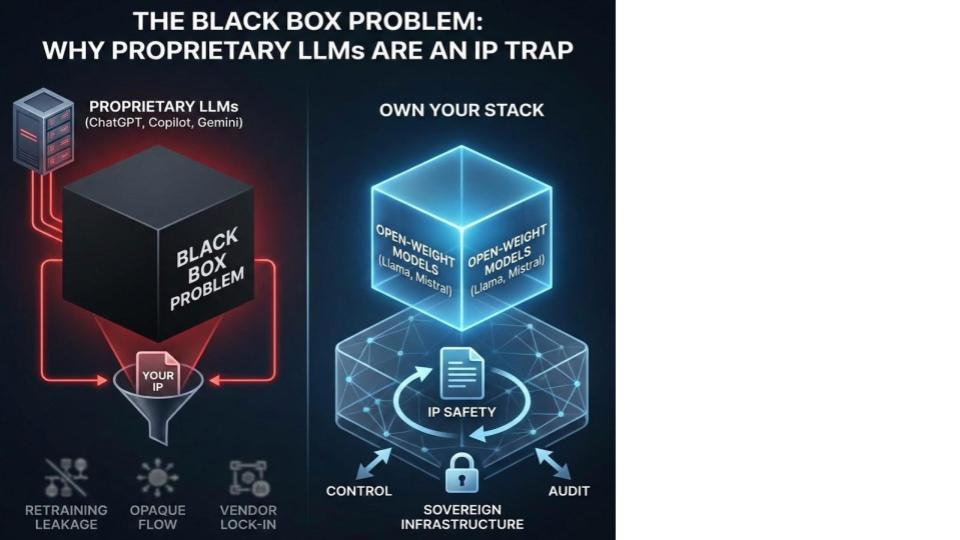
The Black Box Problem: Why Proprietary LLMs Are an IP Trap
The most significant shift in risk profiles for 2026 involves Generative AI. For years, organizations blindly trusted proprietary "Black Box" models like ChatGPT, Copilot, or Gemini. We now know that was a strategic error for IP-heavy industries.
When you feed your proprietary code, trade secrets, or R&D data into a privately owned, multi-tenant LLM hosted on foreign soil, you are effectively handing over your IP. Even with "Enterprise" assurances, the technical reality exposes you to three critical risks:
- Model Retraining & Leakage: Despite contractual promises, the risk remains that your data could inadvertently influence model weights or be retained for "safety monitoring," eventually resurfacing in a competitor's query.
- Opaque Data Flow: You cannot audit where your prompt goes. A query initiated in Toronto might be processed by a GPU cluster in Virginia, instantly subjecting your trade secrets to the US CLOUD Act.
- Vendor Lock-in & Pricing Volatility: If your business logic is tied to a proprietary API, you are at the mercy of that vendor's pricing, uptime, and ethical guidelines.
The Solution: Open Source and Sovereign Control
The only way to truly guarantee IP safety is to own the stack. This means leveraging open-source Gen-AI models (like Llama, Mistral, or other emerging open-weight models) deployed on your own sovereign infrastructure.
Why open source is the future of secure AI:
- Auditable & transparent: With open source, you can inspect the code, understand its behavior, and verify that it adheres to your security and privacy policies — impossible with black-box proprietary systems.
- Stable & community-driven: The vibrant open-source ecosystem provides extensive documentation, community support, and commercial offerings from specialized vendors, ensuring stable operations without single-vendor lock-in.
- Guaranteed IP protection: When deployed on your own infrastructure, no data ever leaves your perimeter. Your proprietary inputs remain entirely under your control, never exposed to foreign jurisdictions or used to train external models.
Hosting Choices: The Physics vs. Contracts Debate
For Legal teams, the battleground has shifted from the contract to the stack. In the past, we relied on Data Processing Agreements (DPAs) and Binding Corporate Rules (BCRs). However, recent geopolitical demonstrations — where services were unilaterally severed or data accessed despite contracts — have proven a hard truth:
Physics beats Law.
When selecting hosting providers in 2026, you must ask three questions:
- Who holds the encryption keys? If the provider holds the keys, they have the data. Full stop. You need Hardware Security Modules (HSMs) that you control, ideally hosted outside the provider's environment.
- Can the support staff access the memory? "Follow the sun" support models are a major leakage point. Ensure your provider offers "Sovereign Operations," where support is restricted to nationals located within the sovereign territory.
- Is the code auditable? For Gen-AI workloads, you must be able to verify exactly what the model is doing with your inputs. Open source is the only way to achieve this transparency.
The 2026 Sovereignty Checklist
To future-proof your organization, align your Legal, Privacy, and IT teams on this checklist:
- Data inventory 2.0: Map not just where data lives, but where it is processed — especially for AI inference.
- Key management: Implement "Hold Your Own Key" (HYOK) for all sensitive datasets.
- Jurisdictional review: Re-evaluate all US-based SaaS providers handling European or Canadian citizen data.
- Exit strategy: Do you have a portability plan? If a geopolitical event cuts off access to a major cloud provider, can you move your workload to a sovereign private cloud within 48 hours?
Conclusion
In 2026, data sovereignty is no longer a "nice to have" — it is the foundation of digital trust. The organizations that thrive will be those that stop relying solely on paper contracts and start building sovereignty into their technical architecture.
Disclaimer: AI contributed to the creation of this article, but it was guided, reviewed and fact-checked by Persevere Consulting's human experts. The content is for general information purposes only and is not legal or management advice.